Threat Model
Before building a Qubes OS architecture, you should develop a basic threat model. This does not need to be perfect, and it will evolve over time as you better understand your needs. Think of it as an ongoing process rather than a single task you complete once.
Identify Your Assets
Start by identifying the things you want to protect. These are your assets.
Examples include:
personal documents
credentials and authentication secrets
financial information
private conversations
photos and memorabilia
work-related data
anything you value and do not want exposed or lost
Assets can be digital or physical, and their value may change depending on context.
Define Potential Adversaries
“Adversary” might sound dramatic, but in security it simply means anyone or anything that could compromise your assets, intentionally or unintentionally.
Typical adversary categories include:
Government or State-Level Actors Although highly unlikely for most people, these actors have significant resources and capabilities. They matter mainly if you have a very specific risk profile (journalism, research, activism, sensitive industries).
Tech Companies and Data Harvesters A far more common concern. Large companies collect massive amounts of telemetry, behavioural data, and metadata. Many users move toward systems like Qubes partly to limit data collection and reduce the attack surface.
Cybercriminals Phishing, ransomware, account takeover attempts, identity theft, and opportunistic attacks fall into this category. This is the “practical reality” for most users.
Other Individuals This covers everything from someone shoulder-surfing your screen, to someone physically accessing your device, to misuse by somebody you share a system with. Physical security and compartmentalisation matter here.
Your Future Self Believe it or not, accidental self-sabotage (deleting files, breaking systems, misconfigurations) is a common adversary. Compartmentalisation helps reduce the damage when you inevitably make mistakes.
Modeling Risk
Once you understand what you want to protect and who you want to protect it from, the next step is to think about how likely each threat is and how much damage it could cause.
You don’t need a complex scoring system. A simple mental model works:
What is the likelihood? (low / medium / high)
What is the impact if it happens? (low / medium / high)
Note
Focus your attention on threats that are high-impact even if they are low-probability. This helps avoid over-engineering while still being realistic.
Visualising the System
Once you have a sense of your assets and risks, it’s helpful to draw your environment on paper. Visualisation makes abstract concepts concrete and helps you understand what Qubes OS actually offers. You will most likely have to restart the drawing multiple times, but to start you off, think of different aspects of your life that do not mix. Work, personal life, government related maintenance, fun hobbies or activities. These kind of isolated factors of your life exist digitally too, so take note and when we start drawing a model similar to the one below, you will know what to fill in and where.
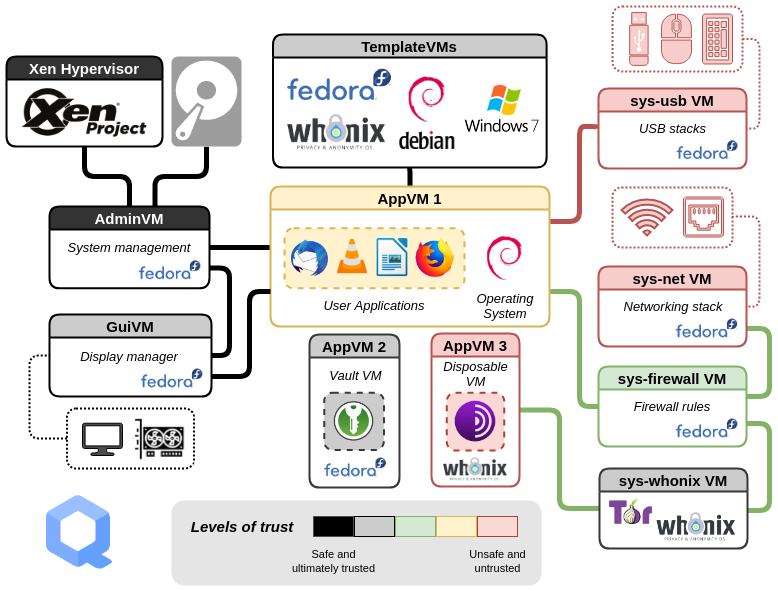
Example of a trust-based architecture within Qubes OS.